Small Team, Big Event: What to Cut, What to Automate, and What to Never Touch
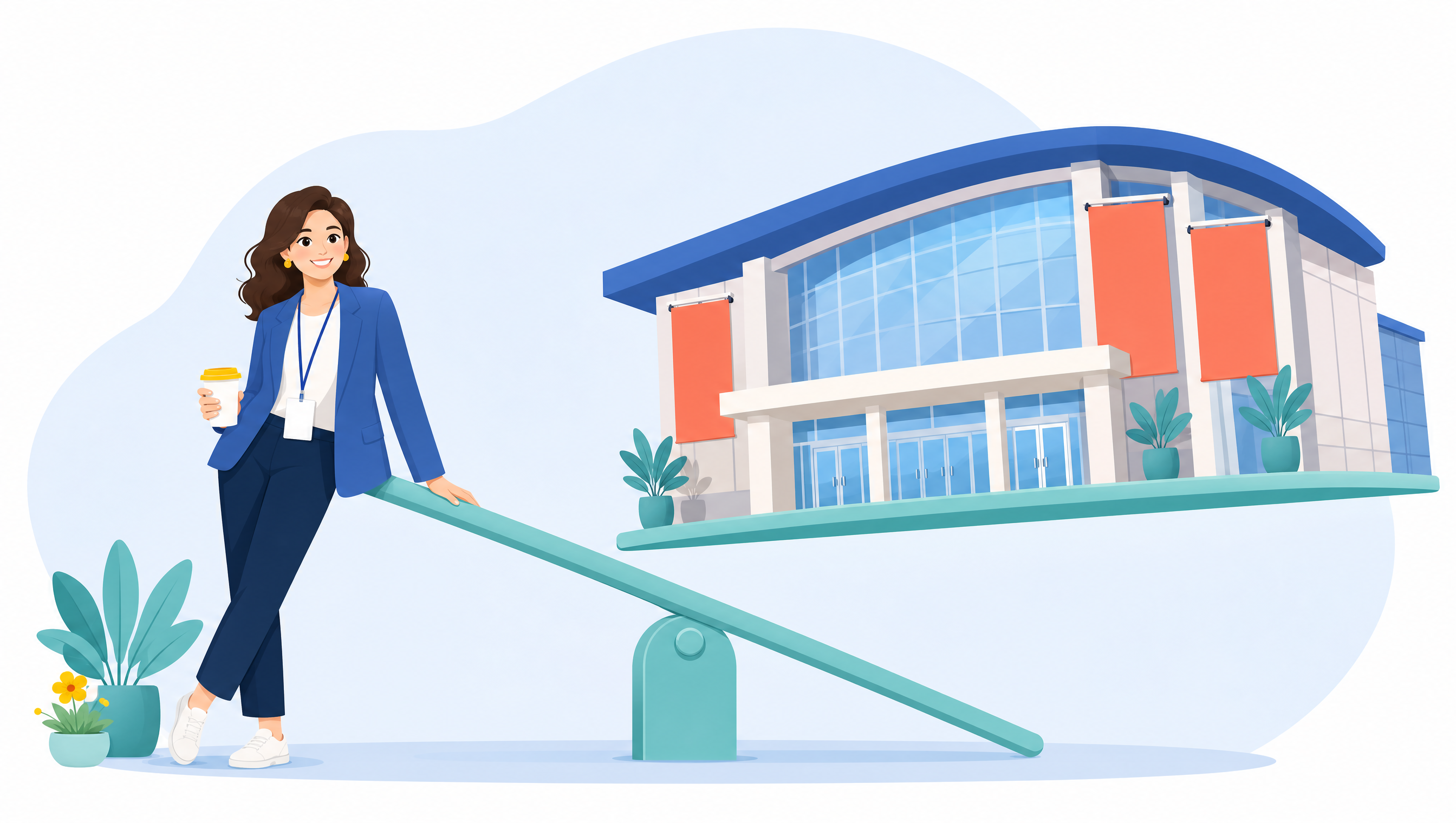
There is a particular kind of person who runs a 3,000-attendee annual meeting with a staff of three. You can spot her at the airport the day before load-in. She is the one with a roller bag full of lanyards, a laptop open to a floor plan, and the specific calm of someone who stopped pretending she could do everything roughly eight months ago.
That calm is the whole skill. It is not energy, and it is definitely not caffeine, although let's not pretend caffeine isn't load-bearing. It is the result of a hundred small decisions about what not to do, made early, on purpose, while there was still time to change her mind.
Big events run by small teams do not succeed because the team worked harder. Everyone works hard. They succeed because somebody did the arithmetic honestly and then acted like it.
The headcount math nobody wants to do
Here is the math.
Three people, working an unsustainable twelve-hour event day, produce thirty-six human hours. Three thousand attendees, each with one small need, produce three thousand interactions. Even if every single interaction takes only forty-five seconds, which it does not, you are short by about two full days of labor that you do not have and cannot buy.
So the question was never "how do we get it all done." The answer to that is: you don't. The question is which of those three thousand interactions deserve a human, and what happens to the rest.
Most teams never ask it out loud. They just discover the answer at 8:15 on day one, in the form of a line out the door and a staff member crying quietly near the coffee. If that sounds familiar, it is worth reading how other teams have closed a staffing gap without hiring for it.
The cut list
Lean teams get famous for what they build. They should get famous for what they kill.
The printed program book is a common first candidate. It costs four figures, it is wrong by the time it ships, and someone has to carry forty boxes of it. The elaborate fourteen-track session grid is often second, not because variety is bad but because a small team cannot staff fourteen rooms, chase fourteen sets of AV notes, or chase down fourteen speakers who have not uploaded slides. Eight tracks run well beat fourteen run badly, every time.
Then there is the long tail: custom-branded everything, the welcome reception nobody has the staff to actually host, the three concurrent networking activations, the sponsor deliverable that one sponsor asked for in 2019 and nobody has had the nerve to retire.
The test is simple and slightly uncomfortable. If this element failed completely and silently, who would notice by lunch? If the honest answer is nobody, you have found a cut. Working through the list this way is also the fastest route to a budget that spends smarter rather than just less.
Three caveats, because cutting badly is worse than not cutting.
Know what is a cost and what is inventory. That program book may be carrying ad revenue. Those extra tracks may be the reason anyone walks the exhibit hall between sessions. If a cut takes exhibitor or sponsor revenue with it, it is not a cut, it is a trade, and you should price it before you make it.
Somebody noticed. The veteran who has come for fifteen years clocks every missing thing, and absent an explanation he will read your intentional, well-run, leaner event as an organization in decline. Say what you cut and why, in the confirmation email, out loud, in your own voice. "We moved the program fully mobile so we could put two more staff on the floor" is a completely different message from silence.
Protect the newcomer scaffolding. Most of what a lean team wants to cut is invisible to regulars and load-bearing for first-timers: the orientation, the thing that tells you where to stand, the one reception where a person who knows nobody meets somebody. Cut the activation. Keep the on-ramp.
And if you work for an association, know that none of this is an operational decision. It is a political one, and the sponsor deliverable from 2019 has a champion. Bring the arithmetic to the committee in the fall, not the cut, and let them reach it with you.
The three jobs software should absorb
Some jobs on an event are not really jobs. They are headcount in disguise, and they are exactly where technology earns its keep.
The door. Check-in is the single highest-volume, lowest-judgment task on the entire event, which makes it the most automatable thing you own. It is also the first impression, which is why teams are nervous about handing it over. Resolve that tension with throughput, not staffing: self-service kiosks with on-demand badge printing turn a thirty-person line into a moving one, and free your three humans to stand next to the line solving the weird cases instead of standing behind a table typing names. There are several ways to shorten that line without adding people, and on a team of three they are all worth doing at once.
Data entry. Every time a human retypes something a system already knows, you have paid twice for the same fact. Registration should flow to badges, badges should flow to session attendance, session attendance should flow to your post-event reporting, and none of those handoffs should involve a spreadsheet and a prayer. The integration work is boring and it is where the hours actually hide.
That includes the handoff most teams forget, which is the one going back out the door. Your exhibitors paid for leads, and the thing they are actually buying is a clean file they can load into their CRM while the show is still warm. A lean team that delivers scanned leads within forty-eight hours, without a human assembling anything, has automated its own renewal conversation. A lean team that promises a report "in a couple of weeks" has automated nothing and has quietly made next year's exhibitor sale harder.
Answering the same question four hundred times. Where is my badge, what room, what time, is lunch included. A mobile agenda, clear signage, and a confirmation email that actually answers these things will absorb most of it. Not all of it. Most.
What you never automate
Now the other side, because a lean team that automates everything produces an event that feels like a self-checkout lane.
The exception path. The VIP whose name is spelled wrong on the badge. The attendee who registered under a company that got acquired. The speaker whose flight is cancelled. These are not edge cases, they are the actual texture of event day, and they are precisely what software is worst at. The entire reason you automated the door was to buy a human being who can stand there and fix these in real time. If you automate the door and then send that person to go do something else, you have not saved labor. You have hidden a failure.
The first ninety seconds. Somebody should be glad a person walked in. Not a screen. This costs you one human standing in the right place, which is the cheapest line item on your budget and the one most likely to get cut by someone looking at a spreadsheet.
There is a third thing here that is not optional, and it is the one lean teams get wrong most often. A room full of self-service kiosks is an accessible check-in only if you have actually checked: a reachable screen height, a staffed path that does not require standing in a line, a seat within sight of the queue, and a fallback for the attendee whose phone is dead or who does not have the app. If you have moved the program entirely to mobile, somebody needs a large-print or printed option on request. Automating the door is supposed to free a human to help. Make sure the human is positioned where the people who need help can actually reach them. Our check-in prep checklist is a reasonable place to start that audit.
Why lean teams win in March
The last thing, and the one that separates teams that pull this off from teams that merely survive it.
A big team can absorb a bad decision in September. They will throw four people and a weekend at it. A team of three cannot. Which means the lean team's only real advantage is that it is allowed to decide early, and to decide less.
Lock the session grid when it is boring to lock it. Not the contents, necessarily, because the keynote you are still chasing will not confirm until six weeks out and the exec may change the title twice. Lock the structure: how many rooms, how many slots, how long, who is responsible. Then leave named holes in it and fill them as they confirm. A structure you locked in March survives a speaker change in September. A structure you are still negotiating in September does not survive anything. Build the badge and registration setup in the quiet weeks and then stop touching it.
Write the day-one run of show while you are calm, because the version you write at midnight the night before will be worse and you will follow it anyway. Pick the three metrics you will actually look at afterward, and instrument them before the doors open, not after, when the data is gone.
And build one spare of everything that is a single point of failure, which, on a team of three, includes the people. One case of flu is thirty-three percent of your operations department. Somebody besides the registration lead needs to know the registration password.
If your spare capacity is volunteers, students, or temps, and for a lot of teams it is, then their training is a deliverable with a deadline, not something you do in the hallway at 7:40 on day one. Twelve untrained helpers will generate more exceptions than they resolve. Four well-briefed ones, each with a one-page card and a name to escalate to, are worth more than all twelve.
Final takeaway
A small team cannot run a large event by doing more. It can only run one by choosing, deliberately and early, which things get a human, which things get a system, and which things simply do not happen this year.
That is not a compromise. Done well, it is a better event than the bloated version, because every single thing left standing is there because somebody decided it had to be.
Three people. One honest cut list. Doors open on time.
This article was written with the help of AI and edited by humans. Graphics were generated with the assistance of AI.
Keep reading
Event Planner Scams in the Age of AI: 9 Threats to Watch For
AI removed every warning sign you were trained to look for. Here are the nine scams hitting event planners right now, and the controls that still work.
Event Food and Beverage Planning: Why Layout Decides How Your Event Feels
Event F&B is really traffic design. The three layout decisions that shape how your event flows: where the food goes, when it opens, and how the line is built.
Event Sponsorship ROI: Helping Sponsors Hit Their KPIs
Events are now the biggest line in the marketing budget. See how planners can partner on KPIs and close the feedback loop to prove event sponsorship ROI.
Bring your next event to life.
See how Expo Pass powers registration, check-in, and engagement from start to finish.
Get a demo