How People Actually Find Your Event in 2026 — And the 7 Channels That Grow Your List Fastest
In this article, we'll cover:
- Why "discovery" is really a list-building problem in 2026
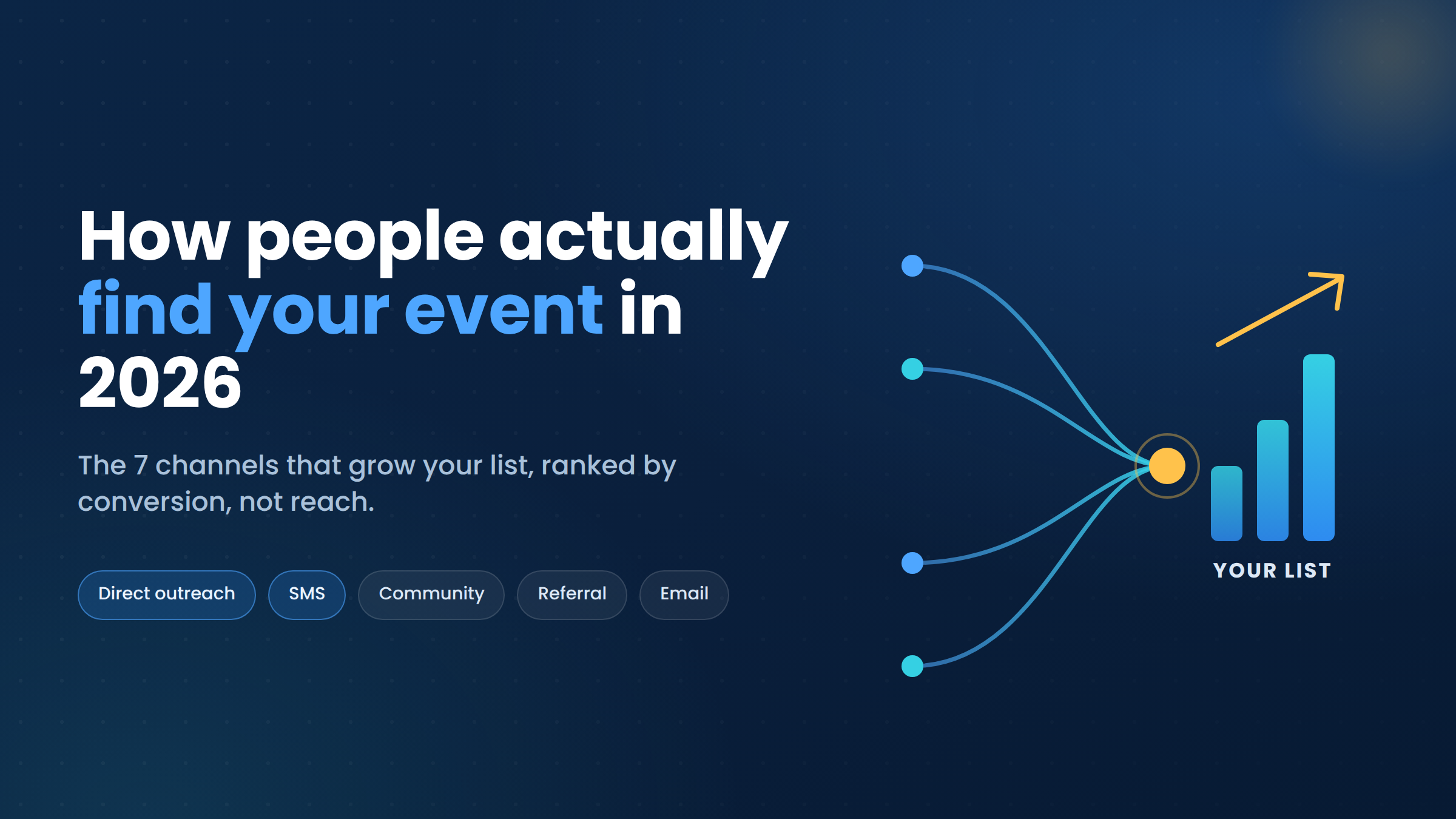
- The 7 marketing channels that actually get your event found, ranked by conversion, not reach
- How to turn one event into a growing audience you own
- A pre-launch playbook to fill your list before registration opens
- FAQs on channels, timing, and first-party data
The uncomfortable truth about getting your event discovered
Here's what nobody tells you when you're planning an event: the hardest part isn't the venue, the catering, or the run-of-show. It's getting the right people to find out it exists in the first place. You can build a flawless experience, but if discovery falls flat, you're speaking to an empty room.
And in 2026, discovery has quietly changed. The channels that felt reliable a few years ago (a big organic social push, a rented email blast, a splashy paid campaign) are getting more expensive and less predictable. Meanwhile, the events that fill up fastest tend to share one thing in common: their organizers own an audience they can reach directly, on demand, every single time. So the real goal isn't just "market this one event." It's build a list you can market to forever.
Let's talk about how to do both at once.
Discovery is a list-building problem in disguise
Most planners think about marketing in terms of a single event: launch, promote, sell out, move on. The organizers who grow year over year think differently. Every event is a chance to capture an audience you can bring back. That's the foundation of any event marketing strategy that compounds instead of resetting to zero each time.
The data backs this up. Event-sourced leads convert to closed deals at roughly a 40% opportunity-to-close rate, the strongest of any channel, according to Vendelux's 2026 event marketing research. But that value only compounds if you're capturing contacts and permission to follow up. If someone discovers your event, attends, and then disappears from your world, you paid full price for a one-night stand.
The shift is subtle but important: stop measuring a channel only by tickets sold this time, and start measuring it by how many people it adds to a list you own.
📊 Fun fact: 76% of attendees decide their event agenda before they arrive, per Vendelux. Discovery and decision-making happen early, which means your list-building has to happen even earlier.
Rank channels by conversion, not reach
The single biggest mistake in event marketing is chasing impressions. A viral post feels great, but reach is vanity if it doesn't turn into people you can contact again. As Posh's 2026 channel analysis puts it bluntly: a 50-person group chat converting at 10% beats 5,000 Instagram impressions at 0.5%.
So here are the channels that actually create discovery in 2026, ordered roughly from highest-converting to widest-reaching. Use the top of the list to close, and the bottom to fill the funnel.
1. Direct, one-to-one outreach (30–50% conversion)
Nothing outperforms a personal message to someone who'd genuinely want to be there. Building a short list of 50–75 plausible attendees and reaching out individually, with real details and a direct link, converts at 30–50%, according to Posh. It doesn't scale infinitely, and that's the point: it's how you land your first anchor attendees, VIPs, and speakers who then attract everyone else.
2. SMS to your past attendees (15–30% conversion)
If you've run events before, your warm list is gold. Text messages see 95%+ open rates versus 15–25% for email, and SMS to a warm list converts around 15–30%. This is only possible if you've been capturing phone numbers and consent at check-in, which is exactly why your registration and on-site data capture matter so much (more on that below).
3. Communities and group chats (5–15% conversion)
Discovery increasingly happens inside private spaces: Slack groups, Discord servers, WhatsApp threads, niche forums, and alumni networks. These audiences are already gathered around a shared interest, so a relevant event lands as useful rather than promotional. You won't reach millions, but you'll reach the right hundreds.
4. Referral and promoter networks (5–12% conversion)
Turn your attendees and a handful of motivated partners into your salesforce. Posh notes that just 3–5 motivated promoters can drive 30–50 extra sales per event. Referral mechanics, like "invite two colleagues, skip the line" or a waitlist that moves you up when friends join, are one of the most reliable ways to grow a list virally without buying reach.
💡 Pro tip: Bake referral into registration itself. When someone signs up, immediately give them a personal share link and a small, real incentive (early access, reserved seating, a swag upgrade). You've just turned one signup into a list-building engine.
5. Email to your owned list (2–8% conversion)
Email isn't the flashiest channel, but it's the one you own: no algorithm decides who sees it. Conversion runs 2–8% to a warm list, and unlike social, its reach doesn't erode over time. This is the asset every other tactic on this list should be feeding. Every text, every referral, every social follower should ultimately land here, ready for your next announcement and every round of post-event marketing.
6. Organic social: Stories, Reels, and short video (0.5–3% conversion)
Instagram Stories, Reels, and TikTok are discovery engines: they reach people who don't follow you yet, especially younger audiences. Conversion per view is low (0.5–3%), but the top-of-funnel reach is real, which is why they earn a spot in any sharp social media strategy. The trick is to always route that attention somewhere you can capture it: a landing page with an email capture, a waitlist, a "notify me" button. Reach you don't capture is reach you rent.
7. Paid ads: Meta and TikTok (0.3–2% conversion)
Paid social works best as an accelerant, not a foundation. It's ideal for larger-capacity events (500+) or for retargeting a warm audience who already visited your page. Expect 0.3–2% conversion cold. Send paid traffic to a capture page first, not straight to checkout, so even the people who don't buy today join your list for next time.
⚡ Practical Advice: Don't spread yourself across all seven. Pick two "closer" channels (direct outreach, SMS, or referral) and one "filler" channel (organic social or paid) per event. Depth beats breadth every time.
Turn one event into an audience you own
Here's where discovery and list growth become the same activity. The channels above create attention, but attention is worthless unless you capture it into first-party data you can use again. That means email addresses, phone numbers (with consent), and a record of who actually showed up.
The mechanics matter more than most planners realize. Registration is your single biggest list-building moment, where an anonymous "interested person" becomes a named contact. On-site check-in is your second: it confirms who genuinely attended, which is the highest-value segment you'll ever market to. Top event technology providers, like Expo Pass, connect registration directly to check-in and badge printing, and attendee data, so the people who discover and attend your event automatically become a clean, reusable list instead of a pile of spreadsheets you'll never reconcile. Find out more »
✨ Expert Advice: Treat every event as a two-way exchange. Attendees give you their attention and contact info; you give them a genuinely useful experience and a reason to opt in for the next one. Add a simple "notify me about future events" checkbox at registration and you'll build next year's launch list this year.
A pre-launch playbook to fill your list before registration opens
The best-attended events in 2026 don't start marketing when tickets go live. They start building the list weeks earlier. Here's a simple sequence:
- Stand up a capture page first. Before you have a full page, publish a one-line "something's coming, get early access" page with a single email field. Every channel points here.
- Open a waitlist with referral built in. A waitlist creates scarcity and gives early fans a reason to recruit friends. Referral waitlists are one of the most repeatable list-growth tools there is.
- Work your warm channels first. Text and email past attendees, post in your communities, and do direct outreach to your VIP shortlist. These convert highest and cost nothing.
- Layer organic and paid on top, pointed at capture, not checkout. Use social and ads to fill the top of the funnel, always routing to your email or waitlist page.
- Open registration to a warm crowd. By launch day, you're not shouting into the void; you're emailing a list that already raised its hand.
🌟 Great Advice: Aim to have a meaningful chunk of your target attendance already on a list before you announce. It's far easier to convert a warm waitlist than to manufacture discovery from scratch under a deadline.
Final Takeaway
Getting your event discovered in 2026 isn't about finding one magic channel. It's about recognizing that every channel's real job is to grow a list you own. Direct outreach, SMS, communities, and referrals close; social and paid fill the top of the funnel; and registration and check-in quietly convert all of it into first-party data you can market to forever. Chase conversion over reach, capture everything into a list you control, and start before you launch. Do that, and each event stops being a cold start and becomes a warmer, easier, more profitable launch than the one before it.
Frequently Asked Questions
What's the single best marketing channel for an event in 2026?
There isn't one; it depends on your audience and whether you have a warm list. For recurring events, SMS and email to past attendees convert highest. For brand-new events, direct one-to-one outreach and community posts get you your first anchor attendees. The best strategy is to pair a high-converting "closer" channel with a broad "filler" channel, and route all of it into a list you own.
How far in advance should I start marketing my event?
Earlier than most people do. Research shows 55% of teams start outreach less than four weeks out, while the stronger cadence is 8–12 weeks. Ideally, you're capturing emails to a waitlist or "notify me" page before registration even opens, so launch day begins with a warm audience instead of a standing start.
How do I actually grow my email list from an event?
Make registration and check-in do the work. Every signup should capture an email and consent, and every attendee should be confirmed at check-in so you know who truly showed up. Add a simple opt-in for future events, and use referral incentives so each registrant brings a friend. Tools like Expo Pass tie registration, check-in, and attendee data together so your list builds itself as people attend.
Is email still worth it when social gets more reach?
Yes, because you own it. Social reach is rented from an algorithm that can change overnight, while your email list reaches exactly who you want, every time. Social's job is discovery at the top of the funnel; email's job is to hold and convert that attention over time. The smartest play is to use social to feed your email list, not replace it.
What's the difference between reach and conversion, and why does it matter?
Reach is how many people see your event; conversion is how many act: register, join a waitlist, or share it. A small, highly relevant audience almost always outperforms a huge, indifferent one: a 50-person group chat converting at 10% beats 5,000 impressions at 0.5%. Optimize for the channels that turn attention into contacts you keep, not just eyeballs that vanish.
Do I need event technology to do this, or can I use spreadsheets?
You can start with spreadsheets, but they break down fast once you're capturing registrations, tracking check-ins, and trying to segment who attended. Connected event technology keeps registration, on-site check-in, and attendee data in one clean, reusable list, which is the whole point of treating discovery as list-building. It's the difference between rebuilding your audience every event and growing it every event.
Keep reading
First-Party Data for Events: Why It Matters in 2026
Third-party cookies are fading, but your event data is thriving. Why first-party data for events is your most valuable asset in 2026, and how to use it.
How to Create an Event Registration Form (Step-by-Step Guide)
A well-designed event registration form is the front door to your event. This step-by-step guide walks you through choosing the right fields, picking the best registration tool, structuring your form for maximum completions, and promoting it across every channel. Build a registration form that converts visitors into confirmed attendees.
What Is an Event Planner? Role, Skills & Day-to-Day Reality
What is an event planner? This guide breaks down the role, core skills like project management and communication, daily responsibilities across the event lifecycle, types of events planners work on, and how technology is changing the profession.
Bring your next event to life.
See how Expo Pass powers registration, check-in, and engagement from start to finish.
Get a demo