What Is a Trade Show? The Complete Guide to Planning, Exhibiting, and Measuring Success
In this article, we'll cover:
- What a trade show is, and how it differs from a conference, an expo, and a consumer show
- Who's actually in the room: organizers, exhibitors, attendees, and sponsors
- How to plan a trade show from the organizer's side, phase by phase
- How to exhibit at one without wasting your budget
- The metrics that prove whether the whole thing was worth it
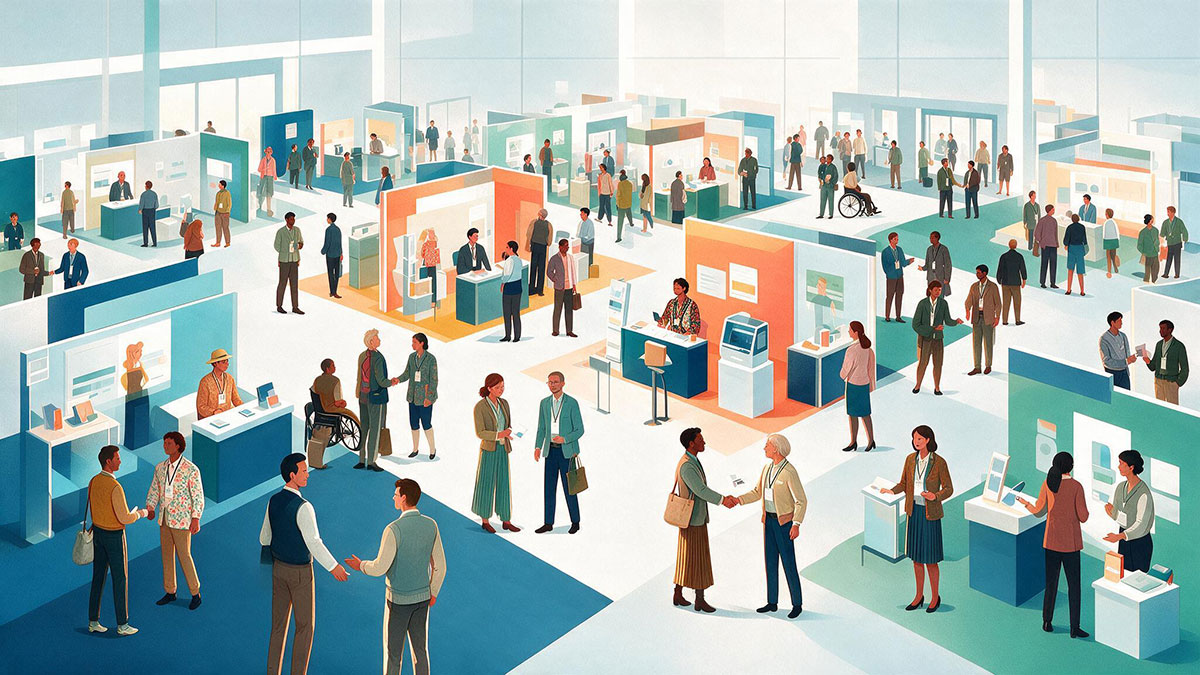
Walk onto a trade show floor an hour before doors open and you'll see the entire business model laid bare: a few hundred companies spending real money for the chance to stand in front of people who might buy from them. Nothing about a trade show is accidental. Every aisle width, badge scan, and coffee station is a decision someone made months ago.
So let's start at the beginning. What is a trade show? It's an industry event where companies in a specific sector gather to display products, meet buyers, and do business face to face. Unlike a conference, where content is the main draw, a trade show is built around the exhibit floor. The booths are the program. Whether you're organizing one or exhibiting at one, understanding how the model works is what separates a profitable show from an expensive week away from the office.
What Is a Trade Show, Exactly?
A trade show is a temporary marketplace. Organizers rent a venue, sell floor space to companies that want to reach a particular audience, and then spend months driving the right buyers through the door. Exhibitors build booths, staff them with salespeople, and try to leave with more qualified pipeline than the show cost them.
The defining characteristic is that trade shows are business to business and usually closed to the general public. You typically need to prove you work in the industry to get a badge. That restriction is the product: exhibitors are paying for a room where nearly everyone is a potential customer.
Most trade shows share a few structural traits:
- A defined vertical. Dental equipment, commercial construction, specialty food, cybersecurity. Narrow beats broad.
- An exhibit hall at the center. Booths are sold by the square foot, usually in 10x10 increments.
- A supporting program. Keynotes, breakout sessions, and certification tracks that give attendees a reason to justify the trip.
- A recurring cadence. Annual is standard. Regional editions are common for larger brands.
- Two customers, not one. Organizers sell tickets to attendees and space to exhibitors, and both groups have to show up for the model to work.
That last point is the one people miss. A trade show organizer is running two businesses at once, and each depends entirely on the other. Thin attendance means exhibitors don't renew. Weak exhibitor rosters mean attendees stop registering. Everything else in this guide flows from keeping those two flywheels spinning.
Fun fact: The Leipzig Trade Fair in Germany has been running in some form since the 12th century, which makes the trade show one of the oldest continuously operating marketing channels in existence. The badge scanners are new. The premise is not.
Trade Show vs. Conference vs. Expo: What Is a Trade Show Not?
These words get used interchangeably in casual conversation and precisely in contracts, which causes a surprising amount of confusion when you're comparing events to attend or sponsor.
A conference is organized around content. The agenda is the product, attendees pay to learn, and any exhibit space is a secondary revenue stream tucked into a hallway. If you're building one of these, your energy goes into the session program and run of show rather than the floor plan.
A trade show inverts that. The exhibit hall is the product, sessions exist to pull people into the building, and the organizer's revenue is weighted heavily toward booth sales and sponsorships.
An expo or exposition is functionally a trade show, though the term often implies a larger footprint or a public-facing element. Many events use "expo" in the name purely because it sounds bigger.
A consumer show looks like a trade show but sells tickets to the public. Home and garden shows, auto shows, and bridal expos fall here. The booth mechanics are similar, but the buyer is an individual rather than a company, and the sales cycle ends at the booth instead of starting there.
A hybrid show blends a real conference program with a real exhibit hall, and most large industry events have drifted in this direction. Attendees want education, exhibitors want traffic, and giving both groups what they want is how you grow year over year.
💡 Pro tip: When you're evaluating whether to exhibit somewhere, ignore the event's name entirely and ask the organizer for the attendee-to-exhibitor ratio. Anything below roughly 8 to 1 means you'll spend the week talking to your competitors.
Who's in the Room: The Four Stakeholders
Understanding a trade show means understanding that four groups walk in with completely different definitions of success.
Organizers own the event and carry the financial risk. They sign the venue contract, set the exhibitor pricing, drive registration, and manage everything from lead retrieval systems to badge printing. Their success metric is net revenue plus rebooking rate for next year.
Exhibitors buy space to generate pipeline. They're measuring cost per qualified lead and, eventually, closed revenue attributable to the show. A booth that generates 400 badge scans and zero opportunities is a failure, no matter how good the aisle traffic looked.
Attendees come to solve problems. They're evaluating vendors, comparing options, learning what's new, and reconnecting with people they only see once a year. They will forgive a mediocre keynote. They will not forgive a 40 minute registration line.
Sponsors buy visibility rather than floor space. Lanyards, charging stations, aisle signage, the wifi password screen. They want impressions and brand association, and they need proof of both after the show.
Every real decision an organizer makes involves trading one group's experience against another's. Wider aisles improve attendee flow and reduce sellable square footage. A packed session schedule boosts education value and empties the exhibit hall at exactly the wrong time. Good shows manage these tensions deliberately rather than discovering them on site.
How to Plan a Trade Show: The Organizer's Playbook
Organizing a trade show is a 12 to 18 month project for anything of meaningful size. Here's how the phases actually break down.
12 to 18 months out: Foundation
Lock the venue and dates first, because everything downstream depends on them. Check the industry calendar obsessively for conflicts, and remember that a competing show two weeks before yours will cost you exhibitors, not just attendees.
Build the financial model before you sell anything. You need a break-even booth count, a break-even attendance number, and an honest read on your fixed costs. Set your exhibitor pricing tiers and your floor plan in the same sitting, since premium locations near entrances and food service carry a premium price.
9 to 12 months out: Exhibitor sales
Open exhibitor sales with your renewals first. Last year's exhibitors, especially the ones who rebooked on site, are your cheapest revenue. Then work outward to prospects who exhibit at adjacent shows.
This is also when you should have your exhibitor management software in place. Managing 200 booth contracts, insurance certificates, booth staff registrations, and shipping deadlines in a spreadsheet works right up until the moment it catastrophically doesn't.
6 to 9 months out: Program and marketing
Build the session program and confirm keynotes. Announce speakers as you land them rather than saving them for one big reveal, because each announcement is a marketing moment.
Open attendee registration. Early bird pricing should be genuinely better than standard, and the deadline should be real. Discounts that quietly extend forever train your audience to wait.
3 to 6 months out: Operations
Order everything with a lead time: signage, badges, printers, furniture, and AV. Finalize your registration and check-in plan, including how many stations you need and where they go. Send exhibitors their service kits with every deadline clearly marked.
The final 90 days: Execution
Marketing intensity peaks. Exhibitor communication becomes weekly. Your on-site staffing plan gets built, your run of show gets written, and you walk the venue at least once with your floor plan in hand.
⚡ Practical Advice: Build your registration and check-in flow before you build your marketing campaign. Nothing kills a show's reputation faster than a great campaign that drives 3,000 people into a bottleneck at the door. Top event technology providers, like Expo Pass, connect registration directly to on-site check-in and badge printing so the badge prints in seconds instead of minutes. Find out more »
The Trade Show Checklist Every Organizer Needs
Even experienced teams run these events off a written checklist, because the failure mode is never the big obvious thing. It's the shipping deadline nobody flagged or the electrical order that never went in.
At minimum, your trade show checklist should cover:
- Venue and contracts: dates, space, load-in and load-out windows, union rules, insurance requirements
- Budget: revenue targets by stream, fixed costs, contingency of at least 10 percent
- Floor plan: booth inventory, aisle widths, fire lanes, food and beverage placement, sponsor activations
- Exhibitor management: contracts, payments, service kits, staff registrations, shipping deadlines
- Registration: pricing tiers, badge categories, data fields, on-site check-in stations
- Program: sessions, speakers, room assignments, AV needs
- Marketing: email sequences, paid campaigns, exhibitor co-marketing kits, press outreach
- On-site operations: staffing plan, run of show, signage, emergency procedures
- Post-event: surveys, lead delivery, rebooking, financial reconciliation
If you want the fully expanded version, our trade show checklist breaks all of this into 50 line items organized by phase. Print it, assign an owner to each line, and review it weekly in the final quarter. The checklist isn't there to make you feel organized. It's there so that when three things go wrong at once during load-in, the other 47 are already handled.
How to Exhibit at a Trade Show Without Wasting the Budget
Most exhibitors lose money at trade shows, and almost always for the same three reasons: they picked the wrong show, they staffed the booth badly, or they never followed up.
Pick shows by audience, not by size. A 900 person regional show where every attendee matches your ideal customer profile will outperform a 30,000 person mega-show where you're one booth in a sea of them. Ask organizers for attendee demographics by job title, company size, and buying authority. If they can't produce that, that tells you something too.
Budget past the booth. Floor space is usually 25 to 30 percent of your true cost. Booth build, shipping, drayage, electrical, internet, travel, lodging, staff time, giveaways, and lead capture all stack on top. Build the full number before you commit, then divide it by your realistic lead target to get a cost per lead you can actually defend.
Staff it with people who can qualify. Booth duty is not a reward for tenure. You want people who can open a conversation with a stranger, disqualify politely, and hand off cleanly. Two great staffers beat five mediocre ones, and everyone should be off their phone.
Design for the walk-by. Attendees give your booth roughly three seconds. Your top-line message needs to be readable from 15 feet and answer "what do you do and why should I care" without jargon. There's a whole craft to this, and our guide to trade show booth ideas that attract visitors covers the tactics that consistently pull traffic.
Capture leads properly. This is where most of the money leaks out, and it's the one line item where the right lead capture tools pay for themselves in a single show. Handwritten notes and business card fishbowls produce unusable data. Proper lead retrieval scans the badge, attaches qualifying answers and notes to the record, and pushes it into your CRM the same day, while the conversation is still fresh in everyone's mind.
For the tactical side of preparation, from shipping timelines to what actually belongs in the booth crate, build a proper trade show exhibitor checklist rather than trusting your memory of last year, and read up on how exhibitors get the most out of an event before you finalize your goals.
✨ Expert Advice: Book 30 percent of your booth conversations before you arrive. Email your target account list two weeks out, offer a specific time slot, and give them a reason to come by that isn't a free t-shirt. Exhibitors who do this consistently report dramatically better lead quality than those who wait for aisle traffic.
Measuring Trade Show Success: The Numbers That Matter
The reason trade show budgets get cut is that nobody measured the last one properly, and measuring event ROI is a discipline, not a spreadsheet you fill in on the flight home. Both sides of the aisle need real numbers.
For organizers, track:
- Total and verified attendance, separated clearly. Registrations are not attendance. Badge scans at the door are.
- Attendee-to-exhibitor ratio, the single best proxy for exhibitor satisfaction.
- Exhibit hall dwell time, measurable through session and hall scan data.
- On-site rebooking rate, the strongest leading indicator of next year's revenue.
- Net promoter score, collected from attendees and exhibitors separately, since they'll differ.
- Revenue per square foot, which tells you whether your pricing and floor plan are working.
For exhibitors, track:
- Cost per lead: total show investment divided by qualified leads, not total scans.
- Lead quality mix: the percentage of captured leads that meet your qualification bar.
- Pipeline generated: total opportunity value sourced from the show within 90 days.
- Closed revenue and payback period: the number that determines whether you rebook.
- Follow-up speed: median hours from scan to first touch. Under 48 is good. Under 24 is better.
The follow-up metric deserves special attention because it's the cheapest thing to fix and the most commonly ignored. Leads captured on Tuesday and emailed the following Monday have gone cold, and you already paid for them. Set the follow-up sequence up before you leave for the show, not after you get back.
The Trade Show Mistakes That Show Up Every Year
A few patterns repeat at nearly every event, and all of them are avoidable.
Underestimating check-in. Registration lines are the first impression of your entire event, and they compound. Model your arrival curve honestly, because most attendees show up in a 45 minute window before the opening keynote, not evenly across the morning.
Scheduling sessions against hall hours. If your best content runs while the exhibit hall is open, your exhibitors will notice the empty aisles and mention it when you call about renewals. Protect dedicated hall time.
Treating exhibitors as a revenue line instead of a customer. The organizers with the highest rebooking rates are the ones who help exhibitors succeed: pre-show marketing kits, traffic-driving activations, quality lead data, and an honest post-show report.
Skipping the debrief. Do it within two weeks, while people still remember specifics. Financial reconciliation, survey data, staff observations, and a written list of changes for next year. Institutional memory is worth more than any single tactic.
Related Reading
Each section above links out to a deeper guide, and they're worth bookmarking as a set. The organizer checklist expands this article's planning phases into 50 assignable line items. The exhibitor checklist covers what to pack, plan, and promote in the weeks before you travel. The booth ideas guide gets tactical about pulling aisle traffic once you're there. The exhibitor management software guide is for organizers past the spreadsheet stage. And the lead retrieval guide explains how booth conversations actually become pipeline instead of a stack of unusable notes.
Read together, they cover the full arc: choosing and planning the show, executing it, and proving it worked.
Final Takeaway
A trade show is the only marketing channel where your entire addressable market walks past your door in three days. That concentration is exactly why it's expensive and exactly why it's worth doing well. Organizers who obsess over the two-sided flywheel, keeping attendees and exhibitors equally happy, build events that compound for decades. Exhibitors who choose shows carefully, staff their booths with real qualifiers, and follow up within 24 hours turn a line item into a pipeline engine. The difference between the shows that work and the ones that don't is almost never budget. It's the planning that happened nine months earlier.
Frequently Asked Questions
What is a trade show and how is it different from a conference?
A trade show is an industry event built around an exhibit hall, where companies rent booth space to meet buyers face to face. A conference is built around its content program, with education as the primary draw. Many large events now blend both, but the distinction still tells you where the organizer's revenue and attention are concentrated.
Can anyone attend a trade show?
Usually not. Most trade shows are restricted to industry professionals and require proof of employment or credentials in the sector to register. Consumer shows, like home and garden or auto shows, are the exception and sell tickets to the general public.
How much does it cost to exhibit at a trade show?
Booth space typically runs from a few thousand dollars for a basic 10x10 at a regional show to tens of thousands for a large island booth at a national one. Plan on floor space representing only 25 to 30 percent of your total cost once you add booth build, shipping, drayage, utilities, travel, staffing, and lead capture.
What should be on a trade show checklist?
A complete trade show checklist covers venue and contracts, budget, floor plan, exhibitor management, registration and check-in, program and speakers, marketing, on-site operations, and post-event follow-up. Assign a single owner to each item and review the list weekly in the final 90 days.
How do you measure trade show ROI?
Exhibitors should measure cost per qualified lead, pipeline generated within 90 days, and closed revenue attributable to the show. Organizers should measure verified attendance, attendee-to-exhibitor ratio, on-site rebooking rate, and revenue per square foot. Both sides need lead and attendance data captured digitally, because manual records almost never survive contact with the follow-up process.
How far in advance should you plan a trade show?
Twelve to eighteen months for an event of meaningful size. Venue and dates get locked first, exhibitor sales open around nine to twelve months out, attendee registration opens six to nine months out, and the final 90 days are dedicated to marketing intensity and operational execution.
Bring your next event to life.
See how Expo Pass powers registration, check-in, and engagement from start to finish.
Get a demo