In this article, we’ll cover:
- What lead retrieval actually means (and why it matters more than you think)
- How lead retrieval works for exhibitors and event organizers
- The key features to look for in a lead retrieval solution
- How to turn captured leads into real post-event revenue
- Common lead retrieval mistakes and how to avoid them
What Is Lead Retrieval? A Complete Guide for Exhibitors and Event Organizers
You just spent $30,000 on a booth, travel, and staffing for a three-day trade show. Your team had dozens of great conversations. But when you get back to the office, all you have is a fishbowl full of crumpled business cards and a few scribbled notes on napkins.
That’s the reality for exhibitors who skip lead retrieval. So what is lead retrieval, exactly? It’s the process of digitally capturing attendee contact information during an event so you can follow up, qualify, and convert those leads after the show ends. Instead of relying on paper forms or business card swaps, lead retrieval uses technology (badge scanners, QR codes, or mobile apps) to grab a lead’s details in seconds.
For event organizers, offering lead retrieval is one of the highest-value services you can provide to exhibitors. It directly impacts their ROI, and exhibitors who see clear ROI from your event are exhibitors who come back next year.
How Lead Retrieval Works for Exhibitors
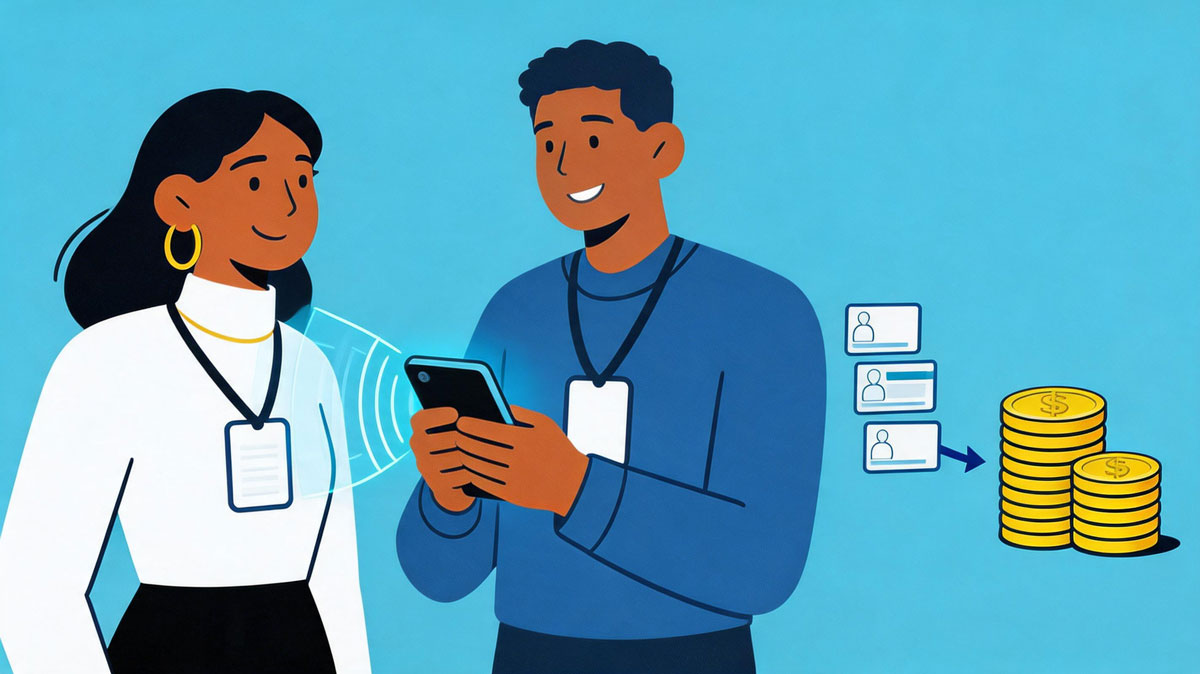
The mechanics are simple. When an attendee visits your booth, your team scans their badge or QR code using a handheld scanner, a rented device, or a mobile app on a phone or tablet. That scan pulls the attendee’s registration data (name, title, company, email, phone) into a digital lead list tied to your booth.
Here’s where it gets powerful. Most modern lead retrieval systems also let you:
- Add custom qualifiers during the scan, like product interest, buying timeline, or budget range
- Tag leads as hot, warm, or cold so your sales team knows who to call first
- Attach notes from the conversation while the details are still fresh
- Export everything to your CRM the same day, so follow-up starts before your competitors even land back home
The best exhibitor teams treat lead retrieval as a live qualification tool, not just a contact collector. Every scan is a chance to capture context that makes your follow-up smarter.
💡 Pro tip: Set up your qualification tags before the show, not on day one. Agree with your sales team on what “hot” vs. “warm” actually means, what product categories to track, and what information matters most. Your scan-and-qualify workflow should take under 10 seconds per lead.
How Lead Retrieval Works for Event Organizers
If you’re organizing a conference, trade show, or expo, lead retrieval is a revenue driver and a retention tool. Here’s why.
Exhibitors pay to be at your event because they want leads. If you offer a built-in lead retrieval system tied to your registration and badge platform, you make their job easier and their results more measurable. That’s a direct line to higher exhibitor satisfaction, stronger renewal rates, and a justification for premium booth pricing.
Event organizers who integrate lead retrieval into their event tech stack can also:
- Sell lead retrieval as a sponsorship add-on or include it in premium exhibitor packages
- Provide real-time analytics to exhibitors showing how many leads they’ve captured
- Use aggregate lead data (anonymized) to demonstrate event ROI in post-show reports
- Reduce friction by connecting registration data directly to the scanning system, so exhibitors don’t need a separate vendor
Top event technology providers, like Expo Pass, connect registration directly to lead retrieval, badge printing, and attendance tracking in one platform. That means exhibitors scan a badge and get instant access to the data the attendee already provided at registration. No double entry. No data gaps.
Key Features to Look for in a Lead Retrieval Solution
Not all lead retrieval tools are created equal. Whether you’re an exhibitor evaluating options or an organizer choosing a system for your event, here’s what separates a great solution from a basic one.
Real-time syncing. Leads should appear in your dashboard instantly, not after a batch upload at the end of the day. Real-time data means real-time follow-up.
Custom qualification fields. You need more than just a name and email. Look for tools that let you add dropdowns, checkboxes, or free-text notes so booth staff can tag leads with context during the conversation.
CRM integration. The fastest path from scan to sale is an automatic export into Salesforce, HubSpot, or whatever CRM your team already uses. Manual CSV uploads slow everything down.
Offline mode. Convention center Wi-Fi is famously unreliable. Your lead retrieval app should work offline and sync automatically when connectivity returns.
Analytics dashboard. Exhibitors want to see how many leads they’ve scanned, which reps are capturing the most, and how lead volume changes across days or sessions. Organizers want aggregate data to prove event value.
Ease of use. If your booth staff needs a 20-minute training session to figure out the scanner, you’ve already lost leads. The best tools are intuitive enough that a temp staffer can pick them up in under a minute.
⚡ Practical Advice: When comparing lead retrieval vendors, ask for a live demo with your actual event data. The slickest sales deck won’t tell you if the scanning speed is fast enough for a high-traffic booth.
Turning Captured Leads into Revenue
Capturing leads is only half the job. The real value of lead retrieval shows up in what happens after the event.
Follow up within 48 hours. Studies consistently show that lead conversion rates drop sharply after the first two days. If you wait a week, your competitors have already made contact.
Segment before you send. Use the qualification tags your team added during the show to create targeted follow-up sequences. Hot leads get a personal email or phone call. Warm leads get a nurture sequence. Cold leads get added to your general marketing list.
Reference the conversation. This is where those notes your booth team attached to each scan pay off. “Great talking with you about upgrading your check-in process” is infinitely more effective than “Thanks for visiting our booth.”
Track attribution back to the event. When a scanned lead eventually converts, make sure your CRM ties that revenue back to the trade show. That’s how you justify next year’s exhibitor budget, and it’s the data event organizers need to prove ROI to their exhibitors and stakeholders.
If you’re building your event strategy from scratch, a solid trade show exhibitor checklist will help you map out every step, from pre-show planning through post-event follow-up.
Common Lead Retrieval Mistakes (and How to Avoid Them)
Scanning without qualifying. Collecting a pile of untagged badge scans is barely better than the fishbowl of business cards. Always add at least a hot/warm/cold tag and a product interest note.
Waiting too long to follow up. Your post-show debrief matters, but it shouldn’t delay outreach. Set up automated email sequences before the event so your first follow-up fires within hours of the show ending.
Using the wrong device. If you’re renting scanners from the venue, test them before the show floor opens. If you’re using a mobile app, make sure it works on your team’s devices and that everyone has it installed and logged in on day one.
Ignoring the organizer’s system. Many organizers, especially those running their events on platforms like Expo Pass, offer integrated lead retrieval that’s already connected to attendee data. Using a third-party scanner that isn’t linked to registration data means you’re getting less information per scan.
Not training booth staff. Your best salespeople might be your worst scanners if they’ve never used the tool. A five-minute walkthrough the night before solves this completely.
For a broader look at how trade shows fit into your marketing and sales strategy, explore our guide on what is a trade show.
Final Takeaway
Lead retrieval is the bridge between a great booth conversation and a closed deal. Whether you’re an exhibitor looking to maximize your trade show ROI or an event organizer looking to deliver more value to your sponsors and vendors, investing in a solid lead retrieval process (and the right technology to support it) is one of the highest-impact moves you can make. Stop collecting business cards. Start capturing qualified leads.
Frequently Asked Questions
What is lead retrieval at a trade show?
Lead retrieval at a trade show is the process of digitally capturing attendee information when they visit an exhibitor’s booth. Exhibitors scan a badge or QR code to instantly collect the attendee’s name, company, title, and contact details. This replaces manual methods like business card exchanges and paper sign-up sheets.
How is lead retrieval different from lead capture?
The terms are closely related, but lead retrieval specifically refers to pulling contact data from a pre-registered attendee’s badge or code. Lead capture is a broader term that includes any method of collecting a prospect’s information, such as landing page forms, social media interactions, or in-person sign-ups. At events, the two are often used interchangeably.
Do event organizers or exhibitors typically provide lead retrieval?
It depends on the event. Many organizers offer lead retrieval as part of their event technology platform or sell it as an add-on service. Some exhibitors bring their own scanning tools. The smoothest experience comes from organizer-provided systems that are already integrated with attendee registration data, since exhibitors get richer lead profiles without extra setup.
How much does lead retrieval cost?
Pricing varies widely. Some event platforms include basic lead retrieval in exhibitor packages at no extra charge. Standalone scanner rentals from venue providers can range from $200 to $500+ per device. App-based solutions tend to be more affordable and flexible. The real cost to evaluate is the cost of not using lead retrieval: lost leads, slower follow-up, and exhibitors who don’t renew.
Can lead retrieval work without Wi-Fi?
Yes, most quality lead retrieval apps support offline scanning. The app stores scanned data locally on the device and syncs it to the cloud once an internet connection is available. This is critical for convention centers and expo halls where Wi-Fi can be spotty, especially during peak hours.
What is exhibitor lead retrieval, and who benefits from it?
Exhibitor lead retrieval is the specific use case where trade show exhibitors use scanning technology to collect and qualify leads at their booth. Exhibitors benefit directly through faster follow-up and better conversion rates. Event organizers also benefit, because exhibitors who capture strong leads are more likely to see ROI from the event and return the following year.