
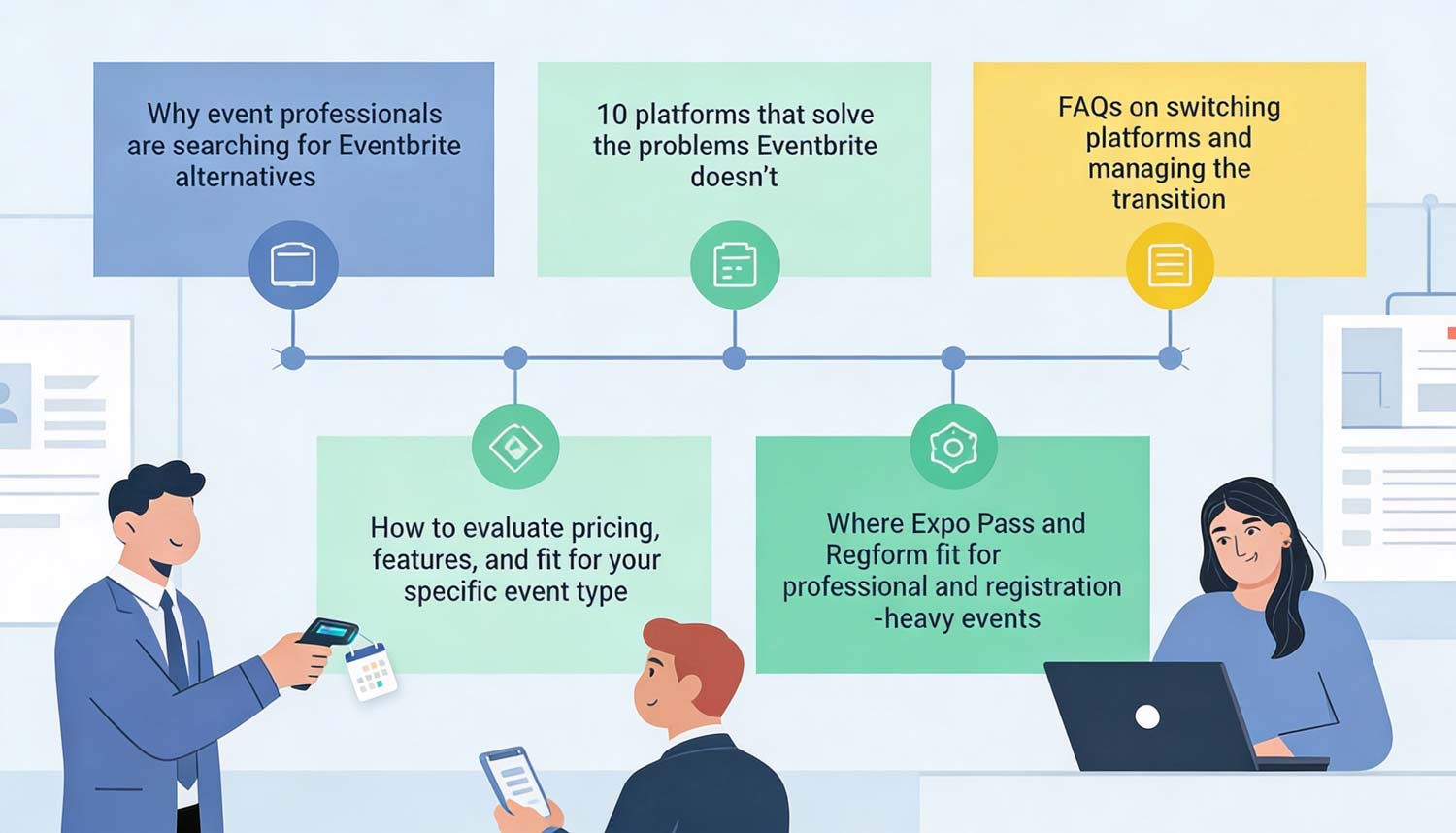
In this article, we’ll cover:
- Why event professionals are searching for Eventbrite alternatives in 2026
- 10 platforms that solve the problems Eventbrite doesn’t
- How to evaluate pricing, features, and fit for your specific event type
- Where Expo Pass and Regform fit for professional and registration-heavy events
- FAQs on switching platforms and managing the transition
Eventbrite Alternatives: 10 Better Options for 2026
Why Event Professionals Are Looking for Eventbrite Alternatives in 2026
If you’ve been using Eventbrite and something feels off, you’re not imagining it. The platform went through a major ownership change this year, and the ripple effects are real.
In March 2026, Italian tech holding company Bending Spoons completed its $500 million acquisition of Eventbrite, taking the company private and delisting it from the New York Stock Exchange. Within weeks, new leadership announced significant staff cuts and a shift toward a leaner operating model. If that sounds familiar, it’s because Bending Spoons has run the same playbook with Evernote, Meetup, Vimeo, and WeTransfer: acquire, cut costs, rebuild.
For event organizers, this creates real uncertainty. Will the features you rely on stick around? Will customer support get harder to reach? Will pricing change again?
Even before the acquisition, many professionals were already exploring eventbrite alternatives for practical reasons: fees that eat into ticket revenue (10-14% per ticket in the US), limited customization options for branded event pages, and a platform that’s built primarily for consumer-facing ticketing rather than professional conferences, trade shows, or corporate events.
If you’re evaluating your options, this guide breaks down 10 platforms worth considering, organized by the type of event they serve best.
💡 Pro tip: Before you start comparing platforms, write down the three things your current tool fails at. That list will cut your evaluation time in half.
How We Picked These Eventbrite Alternatives
Not every platform on this list is a direct swap for Eventbrite. Some are better. Some are different. That’s the point.
We evaluated each option based on five criteria that matter most to working event professionals:
- Pricing transparency: Can you predict your costs before tickets go on sale?
- Registration and ticketing depth: Does it handle multiple ticket types, discount codes, group registrations, and complex pricing tiers?
- On-site operations: Does the platform extend beyond online sales into check-in, badge printing, and day-of logistics?
- Data ownership: Do you keep your attendee data, or does the platform treat it as their asset?
- Scalability: Can it handle a 50-person workshop and a 5,000-person conference without switching tools?
With that framework in mind, here are 10 eventbrite alternatives worth your time.
1. Expo Pass: Best for Conferences, Trade Shows, and Professional Events
If you run conferences, expos, trade shows, or corporate events, Expo Pass is built specifically for the workflows you deal with every day. It’s not a ticketing marketplace. It’s an end-to-end event management platform that connects event registration software directly to check-in, badge printing, lead retrieval, session tracking, and attendee engagement.
What sets it apart:
- Registration to badge printing in one system. No integrations to configure. Attendee data flows from registration through check-in and onto printed badges automatically.
- Lead retrieval for exhibitors. Exhibitors can scan badges and capture leads on the show floor, with data exported in real time.
- Session and attendance tracking. Know exactly who attended which sessions, with CEU/CE credit tracking built in.
- Custom-branded event websites. No Eventbrite branding on your pages, and no marketplace where your event competes for attention with every other listing.
Best for: Multi-day conferences, trade shows, expos, association events, and corporate programs that need more than a ticket page.
Pricing: Custom pricing based on event size and feature needs. No per-ticket percentage fees eating into your revenue.
✨ Expert Advice: If your events involve exhibitors, sponsors, or session-level tracking, a ticketing platform will always feel like a workaround. Start with a platform built for professional events from the ground up.
2. Regform: Best for Fast, Flexible Event Registration and Checkout
If your biggest frustration with Eventbrite is the registration experience itself, Regform is worth a close look. It’s a modern form builder designed specifically for event workflows: sign-ups, multi-step registration, ticket sales, and payment collection, all in a clean, intuitive interface.
What sets it apart:
- Single-page or multi-step registration. Build simple forms or complex multi-step wizards with conditional logic that adapts to each registrant’s path.
- Built-in checkout with Stripe, PayPal, and Apple Pay. No redirecting attendees to a third-party payment page. Promo codes, configurable fees, and refund management are all built in.
- Team collaboration and roles. Invite collaborators, assign permissions, and organize forms by organization, so your entire team can manage registration without stepping on each other.
- Embeddable anywhere. Publish a hosted link, embed inline on your website, or use lightbox mode. Signed prefill links and PostMessage events give developers full control.
- Tracking that matters. Google Analytics, GTM, and Meta Pixel integration out of the box, plus form-level views, completions, and paid order tracking.
Best for: Event organizers who need powerful, customizable registration forms with built-in payment processing, without the bloat of a full event management suite.
Pricing: Currently in early access. Request access at regform.com
💡 Pro tip: If your registration flow involves conditional questions, different pricing tiers, or merchandise add-ons, Regform’s rules engine handles all of that in a drag-and-drop builder, no developer required.
3. Cvent: Best for Enterprise-Scale Event Programs
Cvent is the 800-pound gorilla of enterprise event management. If your organization runs dozens of events per year across multiple regions and needs deep Salesforce integration, hotel block management, and venue sourcing, Cvent delivers at scale.
What sets it apart: Venue sourcing tools, complex registration logic, deep CRM integrations, and enterprise-grade reporting. It handles the full lifecycle from venue RFPs to post-event analytics.
The trade-off: Steep learning curve, longer implementation timelines, and pricing that’s designed for large enterprise budgets. Smaller teams may find it overwhelming.
Best for: Enterprise organizations with dedicated event teams and complex, multi-event programs.
4. Swoogo: Best for Marketing Teams Running Branded Events
Swoogo has earned a loyal following among marketing teams that want real control over how their event pages look and how their registration flows work. Its drag-and-drop builder gives you granular customization over forms, websites, and email workflows, making it a strong fit for field marketing programs and branded experiences.
What sets it apart: Highly customizable registration forms with conditional logic, a clean drag-and-drop website builder, built-in CRM and email automation, and strong integrations with marketing tools like HubSpot and Marketo.
The trade-off: Pricing starts at the mid-market level (around $11,800/year), so it’s not ideal for one-off events or small organizations. Some users note that while the design tools are strong, certain advanced features require workarounds.
Best for: Marketing teams and field marketers running branded events, webinars, and multi-event programs where design control and data flow matter.
5. Ticket Tailor: Best Budget Option for Simple Ticketed Events
If your primary need is affordable ticketing without per-ticket percentage fees, Ticket Tailor is one of the most straightforward eventbrite competitors in the market. It uses a flat-fee or monthly subscription model that can save significant money compared to percentage-based platforms.
What sets it apart: No percentage-based service fees. Pay a flat rate per ticket or a monthly subscription. Clean, simple checkout experience.
The trade-off: Very limited event management features beyond ticketing. No built-in event app, lead retrieval, or on-site tools. It’s a ticketing solution, not an event platform.
Best for: Community events, workshops, fundraisers, and small recurring events where keeping costs low is the top priority.
6. EventMobi: Best for Mobile-First Conferences and Corporate Events
EventMobi combines registration, a native mobile event app, and attendee engagement tools in a single platform. It’s been around for over 15 years and has built a solid reputation with corporate event teams and conference organizers who want a polished mobile experience without stitching together multiple vendors.
What sets it apart: A no-code drag-and-drop app builder (EventMobi Studio) that lets you create fully branded native mobile apps for your events. Built-in features for live polling, Q&A, gamification, wayfinding, and sponsor visibility. Supports in-person, virtual, and hybrid formats from one backend.
The trade-off: Custom pricing starts around $4,995 for basic packages and scales to $20,000+ for enterprise events, so it’s a significant investment. Some users report the interface can feel clunky, and the notification system isn’t as flexible as competitors.
Best for: Mid-to-large conference organizers and corporate event teams who prioritize a branded mobile app experience for attendees and exhibitors.
7. Hopin (RingCentral Events): Best for Virtual and Hybrid Events
After its rapid rise during the pandemic, Hopin was acquired by RingCentral and rebranded as RingCentral Events. The platform still offers solid virtual and hybrid event capabilities, including virtual stages, networking rooms, and expo halls.
What sets it apart: Purpose-built for virtual and hybrid formats. Supports live streaming, breakout sessions, and virtual sponsor booths in one interface.
The trade-off: The platform has gone through significant changes post-acquisition, and some users report a less consistent experience than during Hopin’s peak. In-person event features are limited.
Best for: Organizations that run a significant number of virtual or hybrid events and need a dedicated platform for those formats.
8. Bizzabo: Best for Data-Driven Event Marketing
Bizzabo positions itself as an “Event Experience OS” and is built for marketing teams that want to tie event performance directly to pipeline and revenue. Its analytics and reporting capabilities are deeper than most competitors.
What sets it apart: Strong event analytics, integration with major CRMs and marketing automation tools, and a focus on connecting event data to business outcomes. Klik SmartBadge wearable technology for networking and engagement tracking.
The trade-off: Premium pricing that reflects its enterprise positioning. May be more platform than smaller teams need.
Best for: B2B marketing teams and SaaS companies that need to prove event ROI and tie registrations to pipeline.
9. Eventtia: Best for Large-Scale Consumer and Luxury Brand Events
Eventtia serves major consumer brands and luxury companies, offering both subscription and license-based pricing with strong API capabilities. It’s a good fit for organizations that need white-label solutions.
What sets it apart: White-label capabilities, extensive API ecosystem, and experience with high-profile brand activations. Serves clients in luxury, retail, and education sectors.
The trade-off: Less visibility in the US market compared to other platforms. Enterprise-oriented pricing.
Best for: Large consumer brands, luxury companies, and organizations that need a fully white-labeled event platform.
10. SimpleTix: Best for Venues, Attractions, and Timed-Entry Events
SimpleTix is built for venues, farms, attractions, and experience-based businesses that need timed-entry ticketing, reserved seating, season passes, and box office point-of-sale support.
What sets it apart: Timed entry, reserved seating maps, membership and season ticket support, and integration with Square POS for on-site sales. Pricing at $0.79 + 2% per ticket.
The trade-off: Not designed for conferences or multi-session events. Its strength is venue operations and admissions, not professional event management.
Best for: Venues, attractions, farms, food and drink businesses, and nonprofits running admission-based events.
How to Choose the Right Eventbrite Alternative for Your Events
The right platform depends entirely on what kind of events you run. Here’s a quick decision framework:
If you run conferences, trade shows, or expos: Look at Expo Pass or Cvent. You need registration, on-site check-in, badge printing, lead retrieval, and session tracking in one connected system.
If you need powerful registration and checkout without the full event suite: Regform gives you flexible form building, multi-step workflows, and built-in payment processing in a clean modern interface.
If you run simple ticketed events on a budget: Ticket Tailor or SimpleTix will save you money with flat-fee pricing and straightforward setup.
If you run corporate branded events: Swoogo gives you the design control and marketing integrations your brand team wants.
If you need a mobile-first conference experience: EventMobi delivers a polished branded app with engagement tools built in.
If you run virtual or hybrid events: RingCentral Events (Hopin) or Bizzabo offer purpose-built virtual capabilities.
If you run a venue or attraction: SimpleTix handles timed entry, memberships, and box office sales better than general-purpose platforms.
Understanding what is eventbrite at its core helps clarify the comparison. Eventbrite is primarily a consumer ticketing marketplace. If your events are professional, branded, or operationally complex, you’ve likely already outgrown what it was designed to do.
For a deeper look at how specific eventbrite competitors stack up by event type, we’ve put together a detailed head-to-head breakdown.
⚡ Practical Advice: Don’t just compare feature lists. Run a test event on your top two platforms before committing. The real differences show up in the workflow, not the marketing page.
What About Eventbrite’s Pricing in 2026?
It’s worth understanding what you’re paying today if you’re still on Eventbrite. The platform charges a 3.7% service fee plus $1.79 per ticket, plus a 2.9% payment processing fee per order. On a $50 ticket, that’s roughly $5.09 in fees, or about 10.2%. On a $25 ticket, fees jump to 13.8% as a percentage of the price.
Free events are free to publish, and the optional Pro plan (for email marketing) starts at $15/month. But for paid events at any real volume, those per-ticket fees add up fast.
Many of the eventbrite alternatives on this list offer flat-fee pricing, lower percentage rates, or bundled pricing that includes features Eventbrite charges extra for.
For a comprehensive look at how event management software has evolved beyond basic ticketing, our complete guide covers what modern platforms should offer.
Final Takeaway
The event technology market in 2026 looks very different from even two years ago. Eventbrite’s acquisition by Bending Spoons, combined with staff cuts and an uncertain product roadmap, has made the case for exploring alternatives stronger than ever. But “better” depends on your events. A platform that’s perfect for a 200-person fundraiser gala might be completely wrong for a 3,000-person trade show. Start with what your events actually need, match that against the options above, and run a real test before you commit. Your attendees, exhibitors, and stakeholders will notice the difference.
Frequently Asked Questions
What is the best free alternative to Eventbrite?
For free events, several platforms let you publish without any fees. Ticket Tailor and SimpleTix both offer free event publishing. For professional events with more complex needs, Expo Pass provides custom pricing that bundles registration, check-in, and badge printing without hidden per-ticket percentages. Regform is also currently available in early access for teams that need flexible registration with built-in checkout.
Can I migrate my attendee data from Eventbrite to a new platform?
Yes. Most eventbrite alternatives accept CSV imports of attendee lists. Export your data from Eventbrite before making the switch, and confirm that your new platform can map the fields you need (name, email, ticket type, custom questions). Start the migration well before your next event to allow time for testing.
What happened to Eventbrite in 2026?
Bending Spoons, an Italian tech holding company, completed its acquisition of Eventbrite for approximately $500 million in March 2026. The deal took Eventbrite private, and new leadership has since announced staff reductions and product changes. Bending Spoons has previously acquired and restructured companies like Evernote, Meetup, and WeTransfer.
How do Eventbrite’s fees compare to alternatives?
Eventbrite charges 3.7% + $1.79 per ticket plus 2.9% payment processing per order, which works out to roughly 10-14% depending on ticket price. Several alternatives offer lower-cost structures: Ticket Tailor uses flat-fee or subscription pricing, SimpleTix charges $0.79 + 2% per ticket, and platforms like Expo Pass use custom pricing models without per-ticket percentage fees.
Is Eventbrite still a good choice for professional events?
Eventbrite works well for straightforward consumer ticketing, but professional events like conferences, trade shows, and corporate programs typically need features Eventbrite doesn’t provide: on-site check-in and badge printing, exhibitor lead retrieval, session tracking, and branded event websites without marketplace competition. If your events have grown beyond basic ticketing, it’s worth evaluating eventbrite alternatives built specifically for professional use cases.
What should I look for when switching from Eventbrite?
Focus on five things: pricing transparency (can you predict costs before tickets go on sale?), data ownership (do you keep your attendee data?), on-site capabilities (check-in, badges, lead capture), branding control (custom event pages without platform branding), and integration with your existing tools (CRM, email, marketing automation). Run a pilot event on your shortlisted platform before migrating your full event calendar.