
In this article, we’ll cover:
- Why the first 30 days of planning set the tone for everything that follows
- The most common timeline gaps that derail events before they begin
- How to build a backward-mapped master timeline that actually holds
- Where registration fits into the dependency chain — and why it can’t be an afterthought
- Practical steps to pressure-test your timeline before it’s too late
Why Most Event Timelines Fail Before Registration Even Opens
Most event failures are scheduled weeks in advance. The catering snag, the badge delay, the registration page that went live without a promo code — none of those were surprises. They were the predictable result of a planning timeline that started from today and moved forward, instead of starting from the event date and working backward.
It’s one of the most common mistakes in event planning, and it’s almost invisible until everything stacks up at once.
The Forward-Planning Trap
Here’s how it usually goes: you get the green light on an event, you open a spreadsheet (or a doc, or a sticky note), and you start listing what needs to happen. Venue first. Then catering. Then invites. Then registration.
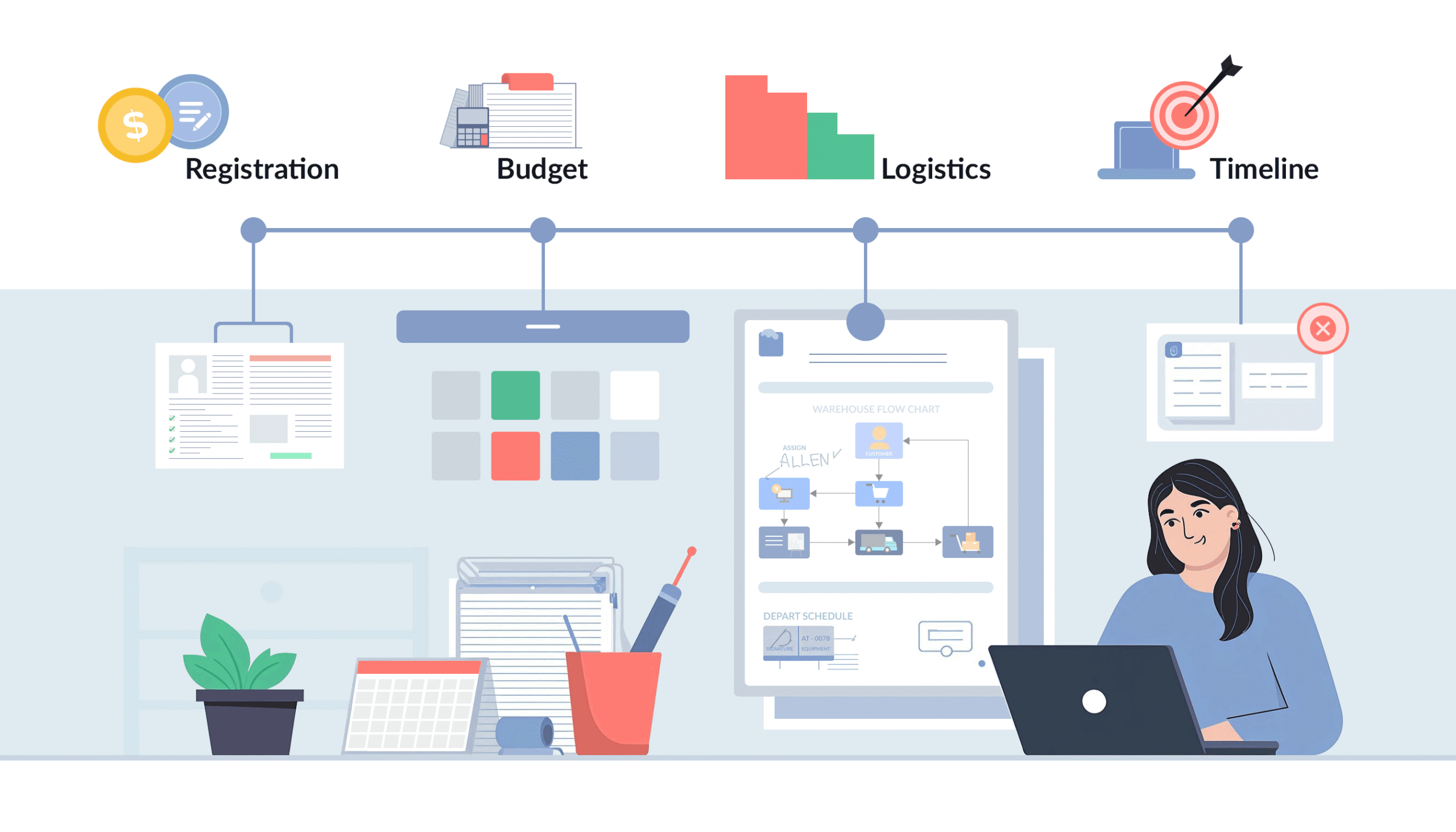
The problem is that this approach treats every task as independent. In reality, most of what you’re managing is a web of dependencies — things that can’t happen until something else is done first. Your event registration platform can’t open until legal approves the cancellation policy. The email campaign can’t go out until registration is live. The badge design can’t be finalized until the sponsor list is locked.
When you plan forward, those connections stay invisible. When you plan backward, they become obvious — and manageable.
The First 30 Days Are Where Timelines Die
The first month of planning is the most dangerous window. Decisions made (or deferred) here ripple outward through everything.
The most common failure points in those first 30 days:
- No confirmed registration launch date. Without a hard open date, every upstream task floats. Vendors don’t prioritize. Approvals drag. Your marketing team can’t schedule anything.
- Approval loops aren’t accounted for. Legal, finance, or executive sign-offs often take 5–10 business days. If that’s not baked into the timeline from the start, you’re already behind before you’ve done anything.
- Vendor lead times are underestimated. Badge printers, AV companies, and caterers all have booking windows. Discovering a vendor needs six weeks when you have four is a painful surprise.
- The registration platform is treated as a Day 1 task. It’s not. It’s a dependency anchor. Everything from your confirmation emails to your attendee communications to your check-in and badge printing workflow flows from what you build there.
💡 Pro tip: Before you write a single item on your task list, write down your three hardest deadlines — registration open, registration close, and event day. Then work backward from each one, and see where the gaps appear.
What a Backward-Mapped Timeline Actually Looks Like
A backward-mapped timeline starts with event day and assigns deadlines based on what must be true for each step to happen.
Start by listing every major milestone: registration live, marketing campaign launch, venue contract signed, catering confirmed, badge proof approved, attendee communications scheduled. Then, for each one, ask: what has to happen before this can be done?
That question is what surfaces dependencies. And once you can see them, you can sequence them — and spot the ones that need to start much earlier than you expected. If you’re building this process from scratch, a solid event planning checklist is the right place to anchor your thinking.
Tools like Expo Pass help teams connect these pieces more practically. When registration, badge printing, and check-in live in the same platform, your timeline tightens up naturally because you’re not waiting on three different vendors to sync data.
Registration Isn’t the Starting Line — It’s the Proof of Concept
Here’s a framing shift worth making: your registration page isn’t where attendees begin — it’s where your planning is tested.
If your registration form asks questions your team hasn’t answered yet (meal preferences, session selections, accessibility needs), you’re not ready to launch. If your confirmation email references a schedule that hasn’t been finalized, you’re not ready. If your promo codes aren’t set up, you’re not ready.
Registration opening is the moment your internal chaos either shows or hides. The goal is to build a timeline where, by the time you hit “publish,” every piece that registration depends on is already resolved. Strong event communications — internal and external — are what keep that chain intact.
✨ Expert Advice: Build a pre-launch checklist specifically for registration — separate from your master timeline. Include legal copy, confirmation email content, form logic, promo codes, and any integrations (CRM, email platform, badge system). Run through it two weeks before your intended launch date to give yourself buffer.
Final Takeaway
The events that run smoothly aren’t the ones with the best last-minute problem-solvers. They’re the ones where the first 30 days of planning surfaced every dependency, locked every approval window, and built a timeline that could absorb the unexpected. Start at the end, work backward, and treat registration launch as a milestone with its own runway — not a task you’ll get to when the bigger things are sorted.
Frequently Asked Questions
How far in advance should I start backward-mapping my event timeline?
For mid-size to large events, start at least 90–120 days out. Smaller events can work with 60 days, but even then, mapping backward from launch day will immediately reveal whether that window is realistic given your vendor and approval lead times.
What’s the most common dependency event planners overlook?
Legal and compliance review. Cancellation policies, refund terms, data collection language — these often need formal sign-off, and that process rarely takes less than a week. Build it into your timeline early, or it will hold everything else hostage.
Should registration open before or after my marketing push?
Registration should be live before your primary marketing push goes out — ideally with a soft launch window to test the form, promo codes, and confirmation flow. Sending a campaign to a broken registration page is one of the most avoidable mistakes in event marketing.
How do I get stakeholders to respect planning deadlines?
Make the dependency chain visible. When stakeholders can see that a delayed approval pushes back registration by two weeks, which pushes back the email campaign, which compresses ticket sales time — the abstract deadline becomes concrete. A shared, backward-mapped timeline does that work for you.
Can event technology help with timeline management?
Yes — particularly when your platform connects registration, communications, and on-site logistics in one place. Top event technology providers, like Expo Pass, reduce the number of handoffs between systems, which means fewer places for timing gaps to hide.